Quick Answer: Almost never. Two blue-eyed parents almost always have a blue-eyed baby because blue eyes require two recessive alleles, and both parents only have recessive alleles to pass on. Non-blue outcomes are possible but extremely rare.
This is one of the most searched genetics questions among parents-to-be. The short answer is "almost never," but the full answer reveals how inheritance actually works, and what rare exceptions exist.
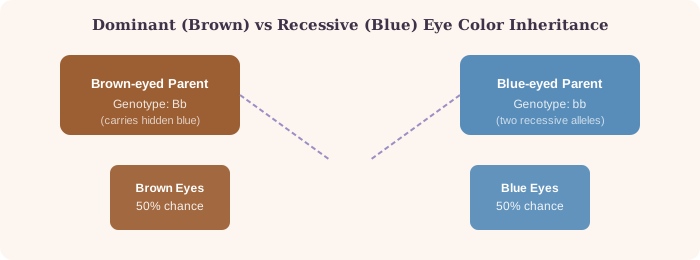
Why Blue Eyes Are Always Recessive
Eye color inheritance centers primarily on two genes: OCA2 and HERC2 on chromosome 15. For simplicity, think of each gene as having a "brown allele" (dominant, labeled B) and a "blue allele" (recessive, labeled b).
To have blue eyes, you need two blue alleles, genotype bb. There's no shortcut. If you carry even one brown allele (Bb), your OCA2 gene is active enough to produce brown pigment, and you'll express brown eyes.
A person with blue eyes has genotype bb. Full stop. Both of their alleles are b.
What Two Blue-Eyed Parents Can Pass On
When both parents are bb, the math is simple:
Every possible combination gives the baby bb. There's no mechanism for a brown allele to appear. According to standard Mendelian genetics, two blue-eyed parents have approximately a 99%+ chance of having a blue-eyed baby.
If you enter two blue-eyed parents into our baby eye color calculator, you'll see nearly 100% probability for blue eyes. That's not a rounding artifact. It reflects genuine genetic reality for this parent combination.
The Rare Exceptions: When Non-Blue Outcomes Occur
Here's where it gets interesting. A handful of documented genetic scenarios can produce non-blue outcomes from two blue-eyed parents:
1. De novo mutations. Spontaneous mutations in OCA2 or related genes can occasionally activate melanin production where none was expected. These are rare, roughly 1 in 100,000 or less, but they do occur.
2. Mosaicism. A parent might have genetic mosaicism, where different cells in their body carry different genetic information. A mosaic parent might "appear" blue-eyed but carry brown alleles in some cells, which could be passed to a child.
3. Undiscovered alleles. Human eye color genetics isn't perfectly two-allele. Genes like SLC24A4, TYR, and IRF4 also contribute. Rare variant combinations at these loci could theoretically introduce additional melanin.
4. Non-paternity. This is the pragmatic explanation that geneticists mention when the math is otherwise impossible. If a brown-eyed child appears from two confirmed blue-eyed parents, non-paternity is statistically the most likely explanation.
Green Eyes From Two Blue-Eyed Parents?
More interesting: two blue-eyed parents can occasionally have a green-eyed baby, and this is slightly less rare than the brown case.
Green eyes sit at an intermediate melanin level. They arise from specific HERC2 variants that partially activate OCA2, plus other modifier genes. It's possible, rarely, for two blue-eyed parents to carry these green-predisposing modifier alleles without expressing green eyes themselves, and to pass them to a child who then shows green.
Run the eye color predictor calculator for blue + blue, and you'll see a small percentage assigned to green (typically 1–5%). That's not rounding error. It reflects this real, documented possibility.
What About Hazel?
Hazel is very unlikely from two blue-eyed parents. Hazel requires moderate melanin and specific structural features in the iris stroma. Since blue-eyed parents carry minimal melanin genetics, hazel outcomes from bb × bb parents would require multiple unlikely genetic events occurring simultaneously.
Family Stories: The "But My Cousin Has Brown Eyes..." Question
Many families have a story of a blue-eyed couple who had a non-blue-eyed child. In most cases, when geneticists investigate, they find one of these explanations:
When both parents genuinely, unambiguously have blue eyes, a brown-eyed child is an extraordinary genetic event requiring documentation of a mutation or mosaicism. It's not simply "genetics are unpredictable."
Running Your Own Prediction
If you want to verify this for your family, enter your eye colors, including grandparent data if you have it, into our free baby eye color predictor. The calculator models the full probability distribution based on your specific genetic inputs.
You can also explore how slightly different inputs change the prediction. Enter hazel + hazel, or blue + green, and watch how even small shifts in parental genetics open up more outcome possibilities. For purely blue + blue, you'll consistently see blue dominating the results, because the genetics really are that clear-cut.