Quick Answer: OCA2 produces the brown pigment in the iris. HERC2 acts as a switch controlling OCA2 activity. Together, they account for most eye color variation in humans. Mutations in HERC2 that turn off OCA2 result in blue eyes; high OCA2 activity produces brown.
When people ask "what gene controls eye color," the honest answer is: mostly two genes working together on chromosome 15. Their names, OCA2 and HERC2, aren't household words, but understanding what they do reveals exactly why eye color works the way it does.
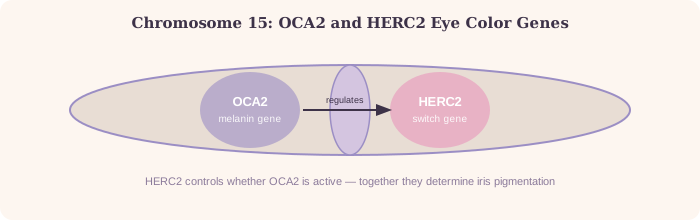
OCA2: The Pigment Gene
OCA2 stands for Oculocutaneous Albinism II. Despite the name, this gene isn't just involved in albinism. It controls melanin production broadly across the iris, skin, and hair.
Specifically, OCA2 encodes a protein that helps transport the amino acid tyrosine into melanocyte organelles called melanosomes. Tyrosine is the raw material for eumelanin, the brown-black pigment that makes eyes dark. Without this transport function, melanin synthesis either slows way down or stops entirely.
The practical result: high OCA2 activity = lots of eumelanin = brown or dark eyes. Low OCA2 activity = little eumelanin = lighter eyes (blue, green, depending on other factors).
Mutations in OCA2 that completely disable the gene produce a form of oculocutaneous albinism, very light or absent pigment in eyes, skin, and hair. But the range of OCA2 activity extends far beyond this extreme, which is why OCA2 variation accounts for much of the normal variation in eye color among people without albinism.
HERC2: The Switch That Controls OCA2
HERC2 (HECT and RLD domain containing E3 ubiquitin protein ligase 2) is a large gene adjacent to OCA2 on chromosome 15. Its relevance to eye color was discovered in 2008 when researchers identified a single nucleotide polymorphism (SNP), a one-letter DNA change, in HERC2's intron 86 that is strongly associated with blue eyes.
That SNP is rs12913832. In the region of HERC2 surrounding this position, there's a DNA sequence that acts as an enhancer for OCA2 expression. When the specific genetic variant associated with blue eyes is present at rs12913832, this enhancer becomes inactive. It can no longer promote OCA2 transcription. The result: OCA2 is silenced, melanin production drops, and eyes appear blue.
Think of HERC2 as a dimmer switch for OCA2:
This is why two people with different HERC2 variants can have the same OCA2 gene and end up with completely different eye colors.
The rs12913832 SNP: One Letter, Massive Effect
The discovery of rs12913832's role in eye color is a remarkable story in genetics. A single nucleotide polymorphism, one base pair out of 3 billion in the human genome, accounts for the majority of the blue-eye vs. brown-eye difference in Northern European populations.
People with the CC variant at this position almost always have blue or gray eyes. People with GG almost always have brown eyes. GA heterozygotes (one of each) typically have brown or intermediate eyes, because the G allele (brown) dominates.
This finding was confirmed across multiple large genome-wide association studies (GWAS) and is now used in forensic genetics, ancestry testing, and yes, consumer DNA eye color prediction tools.
Beyond OCA2/HERC2: The Supporting Cast
OCA2 and HERC2 are the lead actors, but supporting genes add variation:
SLC24A4 (Solute Carrier Family 24 Member 4): Highly relevant for blue vs. green variation. This gene encodes a cation transporter in melanocytes. Specific variants here shift eye color toward green without changing OCA2/HERC2 status by much. The 2012 Nature Genetics GWAS that identified SLC24A4's role showed it was the key differentiator for many people in the blue-green zone.
TYR (Tyrosinase): The enzyme that catalyzes the first step in melanin synthesis, converting tyrosine to DOPA and then to dopaquinone. TYR variants influence total melanin output and contribute to pigmentation of both eyes and skin/hair simultaneously. This is why eye color, hair color, and skin tone are all correlated, even though each has its own dedicated genetic architecture.
IRF4 (Interferon Regulatory Factor 4): A transcription factor involved in melanocyte function and development. IRF4 variants were identified in GWAS as having effects on eye and hair pigmentation. The effect is smaller than OCA2/HERC2 but measurable.
ASIP (Agouti Signaling Protein): Best known for determining whether melanocytes produce brown-black eumelanin or yellow-red pheomelanin. High pheomelanin relative to eumelanin contributes to hazel or amber hues. ASIP variants influence the balance between these two pigment types.
How This Affects Prediction Accuracy
Our baby eye color calculator is built on the simplified Mendelian framework. It uses phenotype (observed eye color) rather than genotype (actual DNA sequence) as input. This approach works well for the majority of outcomes because OCA2/HERC2 dominate eye color expression and their inheritance is consistent enough to generate useful probability estimates.
The 70–85% prediction accuracy cited in genetics research reflects the imprecision introduced by genes beyond OCA2/HERC2. If we could read the actual DNA at rs12913832 and all other relevant loci, prediction accuracy would increase substantially, which is exactly what consumer DNA tests do.
For most expectant parents, the phenotype-based calculator gives sufficiently accurate probabilities to be genuinely useful. For those who want genotype-level precision, a DNA test through services like 23andMe (which reports on eye color genetics as part of their traits panel) can provide allele-level data.
Why This Science Matters Beyond Eye Color
Understanding OCA2 and HERC2 has implications beyond predicting baby eye color:
Forensic genetics: Law enforcement agencies use OCA2/HERC2 analysis as part of phenotyping tools to estimate eye color from crime scene DNA, where a suspect is unknown.
Disease associations: OCA2 mutations are the primary cause of the second most common form of oculocutaneous albinism. Understanding OCA2 function has helped develop better care approaches for people with this condition.
Evolutionary research: The geographic distribution of the HERC2 blue-eye variant is used in population genetics research to trace migration patterns and the spread of this trait from its likely origin in the Baltic region approximately 6,000–10,000 years ago.
The science behind your baby's eye color is deeper than it first appears. If you want to see the probability outcome based on your family's inputs, try the free eye color predictor applies this genetic framework to your specific parent and grandparent combinations.