Quick Answer: Most babies' eyes change color between 3 and 12 months of age as melanin builds up in the iris. Eyes that are still blue or gray at 12 months will almost certainly stay that way.
Nearly every parent asks this question in the first weeks home: "Will my baby's eyes stay this color?" The answer depends on genetics, and on how quickly your baby's iris produces melanin.
Why Almost All Newborns Have Blue or Gray Eyes
The iris gets its color from melanin, the same pigment responsible for skin and hair color. At birth, the melanocytes, cells that produce melanin, are present in the iris but largely inactive. Without much melanin, the iris scatters blue-wavelength light, which is why most newborns appear to have blue or blue-gray eyes, even if they'll eventually develop brown or green irises.
This is a physical effect, not genetics directly. You're seeing light scattering through an iris with minimal pigment, similar to why the sky looks blue, it's called Rayleigh scattering.
The one exception: babies with deeply pigmented genetic backgrounds, particularly those of African, Asian, or South Asian heritage, often have noticeable brown pigment at birth or within the first weeks. In these babies, the melanocytes are genetically programmed to activate more quickly.
The Eye Color Change Timeline
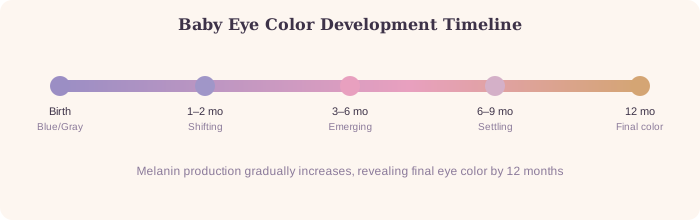
Here's what typically happens month by month:
Birth to 1 month: Most babies have blue, blue-gray, or slate-colored eyes. Even babies who will eventually have brown eyes often start in this range.
1 to 3 months: Melanin production begins to increase. Eyes may start looking slightly muddier or darker. Some babies in this window already show hints of their final color, a faint golden tint may indicate hazel is developing.
3 to 6 months: This is the window when the most significant changes happen for most families. Brown eyes typically become apparent by 3 months. Green and hazel eyes often begin to show their character between 4 and 6 months.
6 to 9 months: Most eye colors are settling in. You can usually see what the final color will be, though it may deepen or sharpen over the coming months.
9 to 12 months: Final color is largely established. The color may continue to deepen or shift in shade, but the hue itself is set for most babies.
After 12 months: Dramatic changes are uncommon. Small shifts in shade, particularly in hazel eyes, which can appear more green or brown depending on lighting, are normal for years. But if your baby has clearly blue eyes at 12 months, they're going to stay blue.
Which Eye Colors Are Most Likely to Change?
Blue eyes are the most likely to change. A baby with blue eyes at birth may develop brown, green, or hazel eyes over the first year, depending on genetic programming and melanin activation rate.
Brown eyes are the least likely to drift once they appear. Once you see brown developing in the iris. It typically deepens but doesn't shift to a different color entirely.
Green and hazel eyes are the trickiest. Both sit in an intermediate melanin range and can shift visibly with changes in lighting and the viewing angle, even in adults. A hazel-eyed baby might look green in some lights and gold-brown in others, and that ambiguity can persist for years.
What Genetics Tells Us About the Timeline
The speed of eye color development is partly genetic. If both parents had their eye colors fully established early, their baby may follow a similar pattern. Our baby eye color calculator can tell you which colors are probable, but it can't predict exactly when they'll show up, because gene expression timing is messier than the base prediction.
What the genetics can tell you: if the calculator shows an 80% probability of brown eyes, expect those brown eyes to appear somewhere in the first 3–6 months. If blue is predicted at 80%, you'll likely still have blue eyes at 12 months.
When Should You Be Concerned?
In most cases, eye color changes are completely normal and cosmetically interesting. However, contact your pediatrician if:
For typical color development in the first year, no medical attention is needed. Eye color changes are one of the harmless genetic surprises of early parenthood.
Using the Calculator to Predict Final Eye Color
While timing varies, the genetics are more predictable. If you want to estimate what color your baby's eyes will eventually become, use our free eye color genetics calculator. Enter both parents' eye colors, and grandparents' if you know them, to get probability percentages for brown, blue, green, and hazel outcomes.
For parents wondering whether that current blue will stay or shift to something else, the calculator gives you a useful probability reference. A high brown probability (say 70%) tells you those blue newborn eyes are likely transitional. A high blue probability means what you see is probably what you'll get.
The best combination of tools: use the calculator for the genetic probability, and use the 12-month mark as your real-world confirmation.