Quick Answer: Eye color is primarily determined by two genes, OCA2 and HERC2, that control melanin production in the iris. More melanin means darker eyes. Less melanin means blue or green eyes.
Before a baby is born, expectant parents are already placing bets on eye color. Grandparents insist "all our family has brown eyes." The other side counters with "but grandma had the most beautiful blue eyes." Who wins?
The answer is in the DNA, and it's more specific than most people think.
The Two Main Eye Color Genes
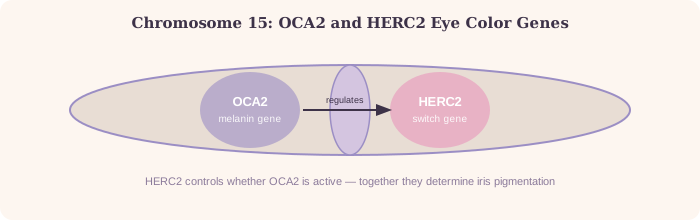
Everything begins on chromosome 15, where two genes sit close together and act as a team:
OCA2 (Oculocutaneous Albinism II gene): This gene's main job is producing the brown pigment eumelanin in the iris. High OCA2 activity = lots of melanin = brown or dark eyes. Low or absent OCA2 activity = little melanin = lighter eyes.
HERC2 (HECT and RLD domain containing E3 ubiquitin protein ligase 2): This gene acts as a regulatory switch for OCA2. Specific variants of HERC2 effectively turn OCA2 off, resulting in little or no brown pigment regardless of what version of OCA2 you carry.
Here's the key insight: you don't need a "blue eye gene" to have blue eyes. You need a version of HERC2 that turns off your OCA2. Blue eyes are, in a sense, brown eyes that were switched off.
How Alleles Work: The Dominant-Recessive Framework
Each person inherits two copies, one from mom, one from dad, of every gene. For eye color:
Green eyes are more complex. They result from partial HERC2 regulation of OCA2, enough melanin to produce a yellowish-green pigment (pheomelanin) combined with light scattering through the iris. This is why green eyes can look different in different light.
The Role of Melanin and Melanocytes
The actual physical process of eye coloring happens in melanocytes, specialized cells in the iris stroma. These cells manufacture and store melanin granules. The density and distribution of these granules, along with iris tissue depth and light-scattering effects, produce the final eye color you see.
Brown eyes: dense melanin packing throughout the iris stroma, front to back.
Hazel eyes: moderate melanin with patches of denser and lighter areas.
Green eyes: low melanin with structural coloring from light interference.
Blue eyes: very little melanin; color comes almost entirely from Rayleigh scattering of light.
This is why two people with "blue" eyes can have very different-looking blues, from gray-blue to vibrant sky blue, without any difference in their underlying genetics. The structural variation in the iris stroma accounts for the shade variation.
Other Genes That Contribute
OCA2 and HERC2 are the heavy hitters, but eye color is technically polygenic, influenced by multiple genes. Research has identified at least 16 genetic loci that contribute to eye color variation, including:
SLC24A4: Contributes to blue versus green variation. Variants here help explain why some HERC2 blue-allele carriers have green eyes rather than blue.
TYR (Tyrosinase): The enzyme that catalyzes the first step in melanin synthesis. TYR variants influence both eye color and skin/hair pigmentation.
IRF4: Involved in melanocyte development. IRF4 variants influence iris pigmentation and have been found in multiple GWAS studies to affect eye color.
ASIP and MC1R: Better known for their role in red hair and freckles, these genes also subtly influence eye pigmentation in ways that can shift hazel toward green or brown.
The combined effect of all these genes is what makes predicting eye color imperfect with phenotype-only inputs. Our baby eye color calculator uses the dominant OCA2/HERC2 framework (simplified Mendelian genetics) to generate probabilities, which is accurate for the majority of common parent combinations.
Why Grandparents Matter So Much
A parent with brown eyes might carry a recessive blue allele they inherited from one of their own parents. They express brown, the dominant allele wins, but the blue allele is in their genome, transmissible to their children.
This is the hidden variable that catches families off guard. Two brown-eyed parents can absolutely have a blue-eyed baby if both are genetically Bb (one brown, one blue allele). Understanding your parents' eye colors helps the calculator infer your likely genotype. That's why adding grandparent data to our eye color prediction tool improves accuracy by a noticeable margin.
You can read more about this specifically in our grandparents eye color inheritance guide.
What Genetics Can and Can't Tell You
Genetics can tell you:
Genetics can't tell you:
For the probability side of the question, the free baby eye color calculator gives you concrete numbers based on your family's specific inputs. It's a practical tool built on the same genetic science described here, just packaged in a way that doesn't require a genetics degree to use.