Quick Answer: Grandparents' eye colors can reveal hidden alleles that their children (your baby's parents) carry but don't express. A blue-eyed grandparent on one side can meaningfully increase the chances of blue eyes in the next generation, even if the parent shows brown.
One of the most common genetics surprises: two brown-eyed parents have a blue-eyed baby, and everyone looks at each other in confusion. "Where did that come from?" The answer is almost always: a grandparent.
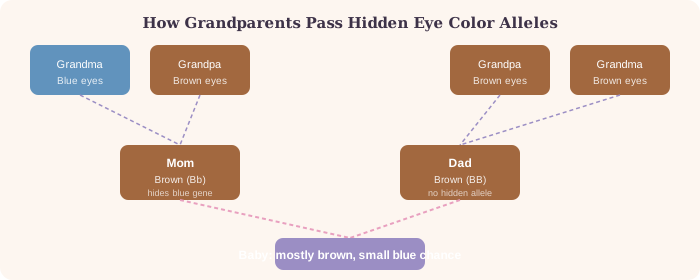
Why Grandparents Are the Hidden Variable
Eye color follows a dominant-recessive inheritance pattern. Brown is dominant. You only need one copy of the brown allele to express it. Blue is recessive. You need two copies.
Now imagine a brown-eyed father whose own mother had blue eyes. That father inherited one blue allele from his mother and one brown allele from his father. He expresses brown (dominant wins), but he's carrying a blue allele in his genome, invisible in his eye color, but very much present and transmissible.
When this father has children, he passes either the brown allele or the blue allele to each child with roughly equal probability. If the mother also carries a recessive blue allele, the child could receive a blue allele from each parent, and end up with blue eyes, even though both parents have brown.
Grandma's blue eyes didn't disappear. They went underground for one generation and surfaced in the grandchild.
How Grandparent Data Improves Calculator Accuracy
Our baby eye color calculator allows you to enter eye colors for all four grandparents in the Advanced Genetics section. Each piece of information helps narrow down the likely genotype of the parents.
Brown-eyed parent with one blue-eyed parent: Almost certainly Bb genotype (one brown, one blue allele). Blue eye outcome for baby becomes meaningfully more probable.
Brown-eyed parent with two brown-eyed parents: More likely BB genotype (two brown alleles). Less likely to pass a blue allele to the baby.
Blue-eyed parent: Always bb by definition. The grandparents' colors don't change the parent's genotype in this case, but knowing the grandparent data can still help refine the other parent's genotype.
Without grandparent data, the calculator has to assume a probability distribution across genotypes based on population averages. With grandparent data, the calculator can make more targeted assumptions. That's the difference between "probably brown" and "brown with a meaningful 25% chance of blue."
Specific Grandparent Scenarios
Scenario 1: Both parents brown-eyed, but maternal grandmother had blue eyes
This tells us mom is almost certainly Bb. If dad is also Bb (which we'd infer from grandparent data), the baby has approximately a 25% chance of blue eyes, despite both parents having brown.
Scenario 2: Brown-eyed dad, blue-eyed mom, paternal grandfather had blue eyes
Dad is Bb (one brown from one parent, one blue from grandfather). Mom is bb. Each child has a 50% chance of blue eyes and a 50% chance of brown eyes. This is a classic Bb × bb cross.
Scenario 3: All four grandparents had brown eyes
Both parents are likely BB or at least more probably BB than Bb. Blue-eye outcomes for the baby become much less likely. Brown is the dominant predicted outcome.
Scenario 4: One grandparent from each parent's side had blue eyes
Both parents are likely Bb. This is the "hidden blue from both sides" scenario. Baby has about a 25% chance of blue, ~56% chance of brown, with green and hazel taking the remaining probability.
The Skip-Generation Effect
Eye color appearing to "skip" a generation is one of genetics' most interesting patterns. It's not magic, it's the predictable result of heterozygous carriers (Bb individuals) who express brown but carry blue.
Research published in Nature Genetics confirms that skip-generation eye color appearances are common in family histories precisely because brown is dominant and Bb individuals are so common in many populations. In Northern European families, where blue-eye alleles are widespread, the chance of producing Bb carriers is high across generations.
This is also why asking grandparents (or looking at old photos) can be genuinely diagnostic. A blue-eyed great-grandparent on one side suggests the lineage has been passing recessive alleles for at least three generations.
What If Grandparent Information Is Unavailable?
If you don't know one or more grandparents' eye colors (common for adopted individuals, families with limited contact, or simply older generations with no photos, the calculator handles this gracefully. Unknown grandparents are treated as a probability distribution rather than a known value, so you'll get a wider confidence range in the prediction rather than a sharper one.
You can also estimate from context: if the parent grew up in a family with predominantly brown-eyed relatives across multiple generations, the parent is more likely BB than Bb. If there are photos of blue or green-eyed family members, Bb becomes more likely.
These are educated inferences, not certainties. The calculator provides probability percentages that honestly reflect this uncertainty, wider distributions when information is limited, narrower ones when grandparent data is available.
How to Use the Calculator With Grandparent Data
In our baby eye color prediction tool:
1. Enter both parents' eye colors in the main section
2. Click "Advanced Genetics (Optional)" to expand grandparent fields
3. Enter whatever grandparent eye colors you know
4. Hit Calculate, results will update to reflect the additional genetic context
Even entering just one or two grandparents' colors can shift the probabilities meaningfully. Complete data (all four grandparents) gives you the most refined estimate.
For background on how the genetics model works, see our guide to eye color gene science. For the specific impact of the dominant-recessive mechanism, the brown vs. blue eyes inheritance article provides a clear breakdown.