Quick Answer: Brown eyes are dominant over blue. You need only one brown allele to express brown eyes. Blue eyes require two recessive alleles, so a single brown allele anywhere in the mix suppresses blue expression entirely.
The dominant-recessive rule is the foundation of eye color prediction. Most people have heard it in passing, "brown is dominant, blue is recessive", but few understand what it actually means in practice. This guide breaks it down with real examples.
What "Dominant" Actually Means
In genetics, dominance isn't about strength, it's about expression. A dominant allele is expressed (shown physically) even when only one copy is present. A recessive allele is only expressed when both copies are the same.
For eye color, brown is dominant because the genetic machinery that produces brown pigment only needs one active copy of the OCA2 gene to start making melanin. The HERC2 gene's "switch" can be half open, and brown still gets produced.
Blue is recessive because blue eyes occur when HERC2 fully suppresses OCA2 activity, and this only happens reliably when a person inherits two copies of the HERC2 blue-switch variant. One copy with a brown-activating variant, and OCA2 turns on.
The Three Possible Genotypes for Brown/Blue
Using B for the brown allele and b for the blue allele, every person has one of these genotypes:
BB (homozygous dominant): Two brown alleles. This person has brown eyes and can only pass on brown alleles. Two BB parents will always have brown-eyed children.
Bb (heterozygous): One brown, one blue. This person has brown eyes (brown is dominant), but carries a hidden blue allele. They could pass either B or b to a child. This is the genotype that creates "genetic surprises."
bb (homozygous recessive): Two blue alleles. This person has blue eyes. Both alleles are blue, so they can only pass on blue.
Why Two Brown-Eyed Parents Can Have a Blue-Eyed Baby
This is the scenario that confuses families most. If both parents have brown eyes, how can a blue-eyed child appear?
The answer: both parents are Bb. Brown-eyed, but each carrying one hidden blue allele.
When a Bb parent passes their alleles to a child, there's a 50% chance they pass B and a 50% chance they pass b. If both Bb parents happen to each pass their b allele to the same child, that child inherits bb, and has blue eyes.
Punnett Square for Bb × Bb:
So from two brown-eyed Bb parents, roughly 25% of children will have blue eyes. Run this combination in our baby eye color calculator and you'll see that reflected in the probabilities, especially if you add grandparent data that reveals the Bb genotype.
How to Know If a Brown-Eyed Parent Is Bb
Here's the detective work: look at the grandparents. If any of a brown-eyed parent's parents had blue eyes, that parent almost certainly inherited a blue allele from them and is genetically Bb, brown-eyed but blue-carrying.
Example: Dad has brown eyes. His mother had blue eyes. His father had brown eyes. Dad inherited the b allele from his mother. He's Bb. His father, if also Bb, passed either B or b to dad, and since dad shows brown, at least one B was inherited.
This is exactly why our eye color predictor tool asks about grandparents. It's not just extra detail, it's the key to narrowing down whether a brown-eyed parent is BB or Bb, which dramatically changes the odds for the baby.
Brown × Blue: The Classic Mix
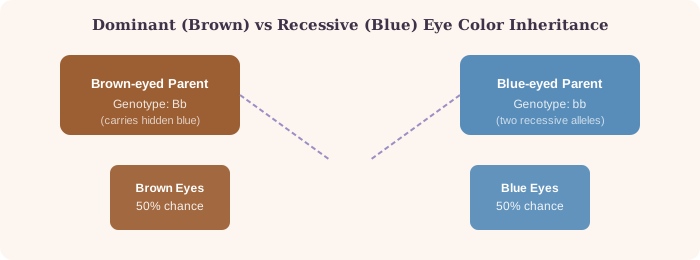
When one parent has brown eyes and the other has blue eyes (bb), the outcomes depend on the brown-eyed parent's genotype:
If brown parent is BB: Every child gets at least one B. All children have brown eyes.
If brown parent is Bb: Each child has a 50% chance of getting B (brown) or b (blue) from the brown parent, and gets b from the blue parent. Result: 50% brown (Bb), 50% blue (bb).
Without grandparent data, our calculator assigns a probability distribution to cover both BB and Bb possibilities. Add grandparent information, and the model can narrow its estimate of whether the brown-eyed parent is BB or Bb, giving you a sharper prediction.
Where Green and Hazel Fit In
Green and hazel eyes aren't explained purely by the brown-blue dominant/recessive model. They arise from additional genetic variants, particularly at the SLC24A4 locus and modifier genes that produce intermediate melanin levels.
For practical prediction purposes:
Our calculator handles all four eye colors (brown, blue, green, hazel) using tables derived from population genetics research. The dominant-recessive model gives you the framework; the calculator does the probability math.
A Practical Prediction Example
Let's say: Brown-eyed mom whose mother had blue eyes, brown-eyed dad whose father had blue eyes.
Both parents are almost certainly Bb. The calculator would give you roughly:
That's a meaningful chance of blue eyes, even though both parents show brown. This is the kind of insight the baby eye color prediction calculator was built to provide. The dominant-recessive logic is correct, but the hidden alleles in Bb parents create real uncertainty that only shows up when you look at the family history.
For more detail on how the full genetics model works, see our eye color genetics guide and the role of grandparents in inheritance.