Quick Answer: Most eye color myths stem from oversimplifying Mendelian genetics. The real rules are messier, and more interesting, than the myths suggest.
Eye color is one of those topics where everyone has heard something definitive from a parent, teacher, or biology class, and much of what circulates is wrong or oversimplified. Here's a myth-by-myth breakdown based on what genetics research actually shows.
Myth 1: Two Blue-Eyed Parents Can't Have a Brown-Eyed Baby
Almost true, but not absolute. Two blue-eyed parents (both genotype bb) have almost no standard genetic pathway to a brown-eyed baby. But genetic phenomena like spontaneous mutations, mosaicism, or extremely rare allele combinations can produce unexpected results. The probability is under 1 in 10,000. So "almost never" is accurate; "impossible" is technically wrong.
Our baby eye color calculator reflects this, blue + blue gives you 99%+ blue, with a tiny residual probability for other outcomes representing these edge cases.
Myth 2: Brown Eyes Are "Stronger" Than Blue Eyes
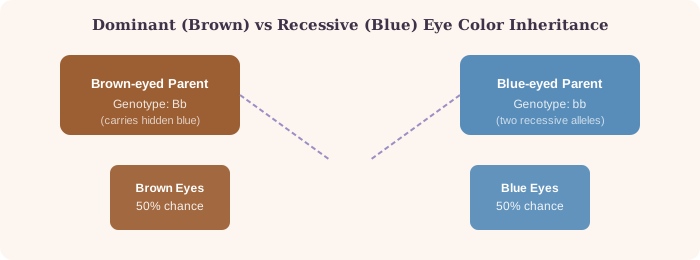
Biologically incorrect framing. Brown isn't "stronger", it's dominant. Dominance in genetics means expressed when present in one copy. It's a function of gene regulation, not strength. A brown-eyed person who is Bb (one brown, one blue allele) has a 50% chance of passing the blue allele to each child. The blue allele is just as active. It simply doesn't express visually in the presence of the brown allele.
Myth 3: Eye Color Is a Simple One-Gene Trait
Outdated, genetics has moved on. The classic biology class version of eye color (two alleles, simple dominant/recessive) was the best model we had in 1907. Research since 2006 has identified at least 16 gene loci contributing to eye color variation. OCA2 and HERC2 are the main players, but SLC24A4, TYR, IRF4, ASIP, and others all contribute. This is why predictions are probabilistic, not certain.
Myth 4: If You Have Brown Eyes, All Your Children Will Have Brown Eyes
False. A brown-eyed parent who is genetically Bb (carrying one recessive blue allele) has a 50% chance of passing the blue allele to each child. If the other parent also contributes a blue allele, the child can have blue eyes. As many as 25% of children from two Bb parents will have blue eyes. Grandparent data in our eye color prediction tool helps determine if a brown-eyed parent is BB or Bb.
Myth 5: Babies with Blue Eyes Will Always Develop Brown Eyes If Parents Are Brown-Eyed
Not necessarily. A brown-eyed parent who is Bb can pass the blue allele to a child. If the child receives blue alleles from both parents, they'll have blue eyes, and those blue eyes will stay blue, not change to brown. The confusion comes from the newborn development timeline: all babies start with blue-gray eyes, and those who carry enough genetics for brown will develop it over 6–12 months. But a child with bb genotype will remain blue.
Myth 6: Eye Color Is Completely Random
Definitely not. Eye color is probabilistic but absolutely not random. Specific parent and grandparent combinations produce specific probability distributions for each eye color. Brown-eyed parents are far more likely to have brown-eyed children than blue-eyed parents. This is predictable genetics, not a coin flip. The calculator quantifies exactly how non-random it is.
Myth 7: Green Eyes Are a Mix of Blue and Brown
Partially misleading. Green eyes aren't a blend of blue and brown parents' colors, they have their own genetic signature involving specific SLC24A4 variants and partial OCA2 activity. You can have two brown-eyed parents who produce a green-eyed child (if both carry the right modifier alleles), or two green-eyed parents who produce a blue-eyed child. Green is its own genetic category, not an average.
Myth 8: Eye Color Tells You About Ancestry
Very loosely, at a population level, not at the individual level. Blue eyes are more common in Northern European populations; brown eyes are more common globally. But millions of Northern Europeans have brown eyes, and green or blue eyes occur in small percentages across many populations worldwide. You can't reliably infer ancestry from individual eye color. It's a probabilistic signal, not a reliable marker.
Myth 9: Hazel Eyes Mean Mixed Ancestry
Not inherently. Hazel eyes arise from specific genetic conditions, not from having parents of different ethnicities. Two parents of the same European ancestry can have hazel-eyed children. Mixed-heritage couples can have hazel-eyed children, but also brown, blue, or green-eyed children. Hazel is a genetic variant, not a biological marker of mixed ethnic background.
Myth 10: Eye Color Changes in Adults
Rarely and usually indicating something worth noting. Normal adult eye color is stable. Adult eye color changes can result from specific medical conditions (Horner's syndrome, pigmentary glaucoma, iridocyclitis) or, rarely, from natural melanin shifts in very light eyes. Age-related yellowing of the cornea can make eyes appear to change color. If an adult notices significant eye color changes, especially in one eye, an ophthalmologist visit is warranted. It's not typical aging.
---
The Bottom Line on Eye Color Science
Eye color genetics is genuinely fascinating precisely because it's more complex than the myths suggest. A simple dominant/recessive framework gets you most of the way to accurate predictions, but the full picture involves multiple genes, modifier loci, and developmental biology.
For practical prediction, the baby eye color predictor gives you probability percentages for all four major eye colors based on your specific family inputs. It won't give you certainty, genetics doesn't do certainty, but it gives you a science-based probability estimate that beats guesswork.
If you want to go deeper on any of these topics, explore the grandparents eye color inheritance guide or the full eye color gene science breakdown.