Quick Answer: Green eyes are rare because they require a specific combination of low melanin, particular HERC2/SLC24A4 gene variants, and iris light-scattering effects. They're most common in Northern and Central European populations, where fewer than 2% of people worldwide have them.
Of all eye colors, green is the most frequently described as "unusual" or "striking." It's also the rarest. Less than 2% of the global population has green eyes. Even in countries where green eyes are most common, Iceland, Ireland, Scotland, the prevalence rarely exceeds 20%.
Why are green eyes so uncommon? The answer lies in a specific, somewhat unlikely combination of genetics.
The Genetics of Green Eyes
Green eyes require three things to happen simultaneously:
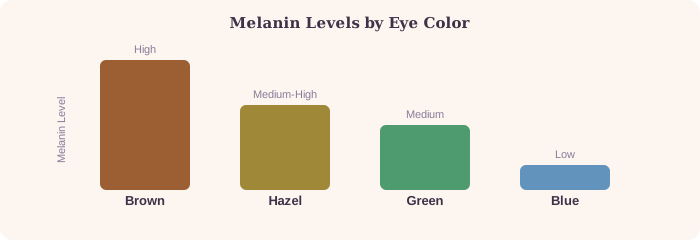
1. Low to moderate melanin production. Green eyes have more melanin than blue eyes but less than hazel or brown. This narrow melanin band, too much for scattering to produce blue, not enough for absorption to produce brown, is what creates the green effect.
2. Specific HERC2 and OCA2 variants. Unlike blue eyes (which arise from nearly full OCA2 suppression) and brown eyes (full OCA2 activation), green eyes require partial activation, and specific gene variants make this happen reliably. Certain HERC2 haplotypes create this intermediate regulation.
3. SLC24A4 variants. This gene, less well-known than OCA2/HERC2, is particularly important for the green phenotype. Research published in Nature Genetics identified SLC24A4 as a key differentiator between blue and green eyes. Variants at this locus can tip moderate melanin toward green expression rather than hazel.
The rarity of green eyes comes from needing all three conditions to be met at once. It's a more specific genetic "address" than either blue or brown.
Green Eyes vs. Hazel: How to Tell Them Apart
Green and hazel are the most commonly confused eye colors in genetics self-reporting. Here's the distinction:
Green eyes: Relatively uniform color across the iris, predominantly in the green or blue-green spectrum. Minimal amber or gold near the pupil. Don't shift dramatically between brown and green.
Hazel eyes: Mixed color, typically gold or amber near the pupil transitioning to green toward the outer iris. Appear to shift between green and brown depending on lighting and viewing angle.
This confusion matters for predictions because green and hazel parents produce different probability distributions in the baby eye color calculator. If you're unsure which you are, try the calculator with both inputs and compare the outcomes, hazel parent combinations will typically show higher hazel and lower green probabilities than green parent combinations.
Which Countries Have the Most Green-Eyed People?
Green eyes cluster in specific geographic regions, which reflects the population history of the alleles responsible:
Outside these regions, green eyes become rare quickly. In East Asia, Sub-Saharan Africa, and South Asia, green eyes are exceptionally uncommon, less than 1% in most populations.
Can Green-Eyed Parents Have Non-Green Children?
Yes, frequently. Green eye genetics isn't dominant in the same way brown is. Two green-eyed parents have the following typical outcome probabilities:
Run this in our eye color genetics calculator: green + green typically gives you around 50% green, 25% blue, and 25% hazel. Brown is almost never produced by two green-eyed parents.
Conversely, two non-green parents can have a green-eyed baby, particularly when both carry relevant SLC24A4 variants without expressing green themselves.
Green Eyes and the Population Genetics Puzzle
Why do green eyes persist at such low frequencies? From an evolutionary perspective, eye color variations like green carry no known survival advantage or disadvantage. They're what geneticists call "selectively neutral." Their distribution across populations reflects genetic drift, founder effects, and migration history rather than natural selection.
The high prevalence of green eyes in Ireland and Iceland likely reflects a founder effect, a small group of people with these alleles established a population, and the alleles spread through that relatively isolated gene pool over generations.
The National Eye Institute notes that research into the selective pressures (if any) on eye color variation is ongoing, but currently the evidence favors neutral drift as the primary explanation.
Using the Calculator When Green Is a Possibility
If you or your partner has green eyes, the baby eye color calculator handles green as a distinct category with its own probability weight. Enter your colors and you'll see how green probability distributes alongside brown, blue, and hazel.
For green × brown pairings, the calculator typically shows brown as the most likely outcome (~50%) with green (~25%) and hazel (~25%) splitting the remainder. For green × blue, green and blue share the probability more evenly.
If green eyes appear frequently across both sides of the family tree, entering grandparent data will shift the probability toward green, because it signals that the relevant SLC24A4 and HERC2 variants are present in the family lineage.
For more about the genes involved, see our OCA2 and HERC2 deep-dive. For understanding where green fits in the full spectrum of eye colors, the what determines eye color guide covers the full picture.