Quick Answer: Hazel eyes result from moderate melanin in the iris combined with Rayleigh light-scattering effects. They appear to shift color because light hits the iris differently at different angles. The genetics are more complex than pure brown or blue.
If you've ever watched someone with hazel eyes and seen them shift from golden-brown to greenish depending on the lighting, you've witnessed one of genetics' more interesting visual effects. Hazel eyes aren't actually changing, it's the physics of light interacting with moderate melanin that creates the illusion.
What Makes Eyes Hazel?
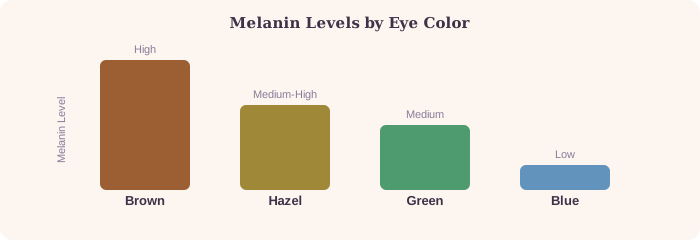
Hazel eyes sit in the middle of the melanin spectrum. They have more melanin than green eyes but less than brown, and this intermediate level creates a layered effect in the iris stroma:
In practice, hazel eyes typically show a warm golden or amber base with greenish or brownish rings toward the outer iris. The exact balance varies a lot from one person to the next, which is why "hazel" can describe eyes that look quite different on different people.
The Genetics of Hazel: Why It's Complicated
Unlike blue eyes, which have a fairly clean genetic explanation (reduced HERC2 activity → reduced OCA2 activity → minimal melanin), hazel eyes involve multiple genetic contributions. The key loci include:
OCA2 and HERC2: A partially active HERC2 switch allows moderate OCA2 expression. This produces melanin, but not the saturated density seen in brown eyes.
SLC24A4: This gene is particularly important for distinguishing blue from green/hazel. Certain variants here push eye color toward the green-hazel range without requiring significant OCA2 expression.
ASIP: The agouti signaling protein gene influences how melanocytes distribute different types of melanin. More pheomelanin (yellowish-red) relative to eumelanin (brown) can tip a moderate-melanin iris toward hazel or amber.
Modifier loci: Several other identified loci, including TYRP1 and DCT, contribute small effects that, in combination, produce the hazel range.
How Hazel Is Inherited
Hazel doesn't follow simple Mendelian rules. It's not dominant or recessive in the classic sense. Instead, hazel represents an intermediate expression that can appear in children even when neither parent has hazel eyes.
Common hazel outcomes by parental combination:
Our baby eye color calculator models hazel as a distinct outcome with its own probability weight based on these parent combinations. When you enter both parents' colors, you'll see hazel as one of the four possible outcomes with a specific percentage.
Why Hazel Eyes Seem to "Change Color"
This is the most common question hazel-eyed adults get from their kids. The color isn't actually changing, hazel eyes are responsive to context in a way brown or blue eyes aren't.
Three reasons hazel eyes look different in different situations:
Ambient light wavelength: In warm (yellow-toned) indoor light, hazel eyes absorb the warm spectrum and the reflected light looks more golden or brown. In cool (blue-toned) or natural light, the scattering effect is stronger and the green component becomes more apparent.
Pupil size: When the pupil dilates in dim light, it covers more of the inner iris. Since hazel eyes often have more golden-brown near the pupil and more green toward the outer edge, dilation shifts the visible color ratio.
Color contrast: The colors worn near the face affect perception. A hazel-eyed person wearing green can look markedly more green-eyed than the same person wearing orange or red.
This perceptual variability doesn't have a genetic component, it's pure physics. But it does make predicting "what hazel will look like" less precise than predicting brown or blue.
Will My Baby's Hazel Eyes Stay Hazel?
Hazel eyes in babies follow the same development timeline as other colors: they develop from melanin accumulation in the first 6–12 months. What makes hazel development particularly unpredictable is that the final balance between melanin density and iris structure takes time to settle.
A baby who appears to have hazel eyes at 3 months might develop more distinctly brown or more distinctly green by 12 months as melanin distribution stabilizes. True hazel, the mixed, variable color, is often only confirmed after the first birthday.
For predicting whether your baby will have hazel eyes, the calculator weighs the probability based on your parent combination. Hazel is most likely when at least one parent carries genes for intermediate melanin expression, which often means one brown and one non-brown parent, or two parents with mixed family backgrounds.
Hazel and the Cultural Label Problem
One complication in hazel genetics research: "hazel" is defined differently by different people and studies. Some researchers classify hazel as a subset of brown; others treat it as a bridge between green and brown; still others define it as a distinct category. This inconsistency makes hazel-specific research harder to interpret.
For our calculator, we follow the most widely used clinical definition: hazel eyes have a golden or amber base with visible green or brown variation across the iris, and appear distinctly different from both solid brown and solid green under standard lighting. If you're unsure whether your own eyes are hazel vs. green or hazel vs. light brown, both interpretations will give you similar outputs in the calculator, because hazel shares genetic architecture with both neighbors on the spectrum.
Explore more about related eye colors in our guide to green eye genetics and our overview of what determines eye color.