Quick Answer: Heterochromia means having two different eye colors or significant color variation within one eye. It's usually benign and can be genetic, but it's worth discussing with a pediatrician to rule out rare underlying conditions.
Occasionally, parents notice that their baby's eyes are developing differently, one eye appears to be heading toward brown while the other stays blue, or one eye has a distinct patch of a different color. This is heterochromia, and it's one of the more visually distinctive genetic traits a child can have.
What Is Heterochromia?
Heterochromia iridis (from the Greek for "different color iris") comes in three forms:
Complete heterochromia: Each eye is a different color entirely. One brown eye and one blue eye is the most common example.
Sectoral (partial) heterochromia: One area of the iris is a different color from the rest. A blue iris with a brown wedge-shaped section, for instance.
Central heterochromia: The area around the pupil is a different color from the outer iris. Many people with hazel eyes have a form of central heterochromia, golden near the pupil, greener toward the edges.
Complete heterochromia is the rarest and most visually striking. Sectoral and central heterochromia are more common and often aren't noticed until the child is older.
What Causes Heterochromia?
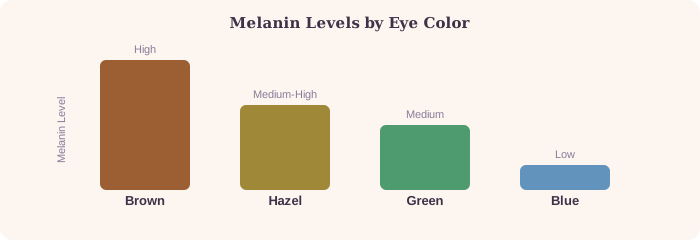
The underlying mechanism is uneven melanin distribution between the two irises. Each iris develops somewhat independently during embryonic development, and the cellular processes that determine melanin density can vary.
Genetic heterochromia: The most common form. An inherited tendency for asymmetric melanin development, often linked to Waardenburg syndrome (a genetic condition that affects pigmentation and hearing) or other pigmentation gene variants. Many cases, however, have no associated syndrome, it's simply a variant.
Acquired heterochromia: Develops after birth or later in life due to:
When heterochromia is present at birth and remains stable, it's almost always benign. Acquired heterochromia, where one eye changes color clearly after previously being the same color as the other, is more likely to indicate something requiring evaluation.
Is Heterochromia Hereditary?
Benign congenital heterochromia can run in families, though the inheritance patterns aren't as clean as standard eye color. If a parent has complete or sectoral heterochromia, there's a modestly elevated probability of a child having it, but it's not a dominant trait that reliably passes on.
If heterochromia in your family is associated with Waardenburg syndrome, which also involves specific facial features and sometimes hearing differences, the inheritance is more predictable (autosomal dominant for Type 1, caused by PAX3 gene mutations).
For standard benign heterochromia without any associated syndrome, the family history is a useful indicator but not a guarantee of transmission.
Can the Eye Color Calculator Predict Heterochromia?
No, and this is an honest limitation of any phenotype-based predictor. Our baby eye color calculator predicts the most likely eye color based on standard genetics, but heterochromia involves developmental variability that happens independently of the standard OCA2/HERC2 prediction framework.
The calculator doesn't include heterochromia as an input or output because it occurs at a frequency (roughly 1 in 1,000 people for complete heterochromia) that doesn't meaningfully affect population-level probability distributions.
If you or your partner has heterochromia, the standard eye color of each parent is still the most useful input for the calculator, use the primary eye color of the heterochromic parent (the color of the majority of the iris, or the color of the non-heterochromic eye if it's complete).
When Should Parents Consult a Doctor?
For babies born with clearly different-colored eyes (complete heterochromia), a pediatric ophthalmologist visit is recommended, particularly to:
1. Rule out congenital Horner's syndrome (often presents with a lighter iris on the affected side, combined with a smaller pupil and slightly drooping eyelid)
2. Assess for any associated conditions
3. Document the baseline eye health for future reference
For sectoral or central heterochromia noticed at 6–12 months, a routine pediatric eye exam is appropriate, no urgency, but noting it for the medical record is worthwhile.
For heterochromia that appears or changes after the first year, a prompt ophthalmology evaluation is warranted.
Famous Examples and Cultural Views
Heterochromia has appeared in many notable individuals throughout history and popular culture, from historical figures like Alexander the Great (reportedly) to contemporary actors and athletes. In many cultures, different-colored eyes have been considered striking, mystical, or a sign of good fortune.
From a purely biological perspective, complete heterochromia is a variant with no known effect on vision quality or long-term eye health in the absence of underlying conditions.
If you're expecting and curious about your baby's likely eye color, start with the free baby eye color predictor. For a deeper look at eye color genetics broadly, see our guide to what determines eye color and our article on the OCA2 and HERC2 genes that control iris pigmentation.