Quick Answer: In mixed-heritage couples, the parent with the higher-melanin eye color tends to be dominant, so a brown-eyed parent of African or Asian heritage with a blue-eyed partner of Northern European heritage will most likely have brown-eyed children, though other outcomes are possible.
When two people from different parts of the world have a child, they're combining gene pools that may have developed quite different baseline eye color distributions. The result can be surprising, and the genetics are genuinely more complex than simple Mendelian prediction suggests.
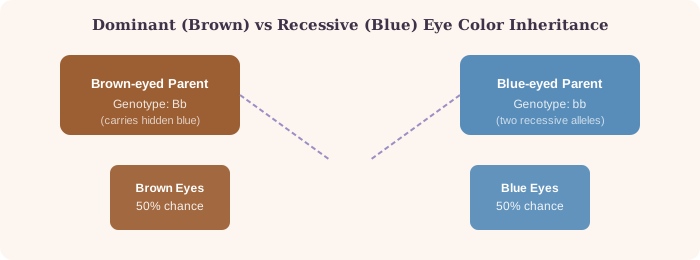
Why Heritage Affects the Baseline
Eye color allele frequencies vary a lot across populations. In Northern European populations (Scandinavia, Ireland, UK), the recessive blue-eye allele is present in a large percentage of people, even many brown-eyed individuals carry it. In East Asian, South Asian, and African populations, the dominant brown allele is overwhelmingly prevalent and most individuals are BB (homozygous for brown), not Bb.
This means:
When estimating outcomes for mixed-heritage couples, our baby eye color calculator uses parent eye colors as the primary inputs. The grandparent data is where you can capture this baseline difference, if all four grandparents from one side have brown eyes and both grandparents from the other side have blue eyes, the model can infer very different genotype probabilities for each parent.
Common Mixed-Heritage Pairings and What to Expect
East Asian + Northern European: An East Asian parent with brown eyes is very likely BB. A Northern European parent with blue eyes is bb. All children of this pairing will likely be Bb, expressing brown eyes, but carrying one recessive blue allele. If the Northern European parent has brown eyes, there's a small chance they're Bb, introducing the possibility (though unlikely) of a blue-eyed child.
South Asian + Northern European: Similar to East Asian + Northern European, but with slightly more variation in the South Asian parent's genotype depending on specific regional background. Southern Indian and Sri Lankan heritage tends toward higher rates of BB; Northern Indian heritage may show slightly higher Bb rates, particularly in mixed regions.
African + Northern European: Brown eyes dominate strongly. An African-heritage parent with brown eyes is very likely BB. Blue eyes from one parent will produce Bb children in virtually all cases, brown-eyed, blue-carrying. A very rare exception would be if the African-heritage parent happens to carry a blue allele, which does occur but is uncommon.
Hispanic/Latino + Northern European: This pairing has more variance than any of the above, because Latino heritage itself spans a wide range of ancestries. A Mexican-heritage parent with brown eyes might be BB or Bb depending on the mix of indigenous, European Spanish, and other ancestry in their family tree. Grandparent data is especially valuable here.
Middle Eastern + Northern European: Brown eyes dominate, similar to South Asian + Northern European. Some Middle Eastern populations have historically higher rates of green and hazel eyes than East Asian populations, so hazel and green outcomes for children are more plausible than from, say, an East Asian + Northern European cross.
What Mixed-Heritage Means for Hazel and Green Outcomes
Hazel and green eyes in mixed-heritage children are often the result of complementary allele contributions from both parents. If one parent contributes OCA2 activity and the other contributes SLC24A4 or HERC2 variants that modulate that activity, intermediate colors can appear.
This is why mixed-heritage families sometimes produce children with eye colors that neither parent has. A brown-eyed South Asian parent and a blue-eyed Northern European parent can occasionally produce a green-eyed child, not because either parent is green, but because the child inherits an intermediate combination of alleles that produces moderate, green-range melanin.
These outcomes are harder to predict precisely because they depend on which specific alleles are present, not just what eye color the parents express. The probability is real but typically low (5–15% for green or hazel in high-melanin × low-melanin pairings).
Getting the Most From the Calculator
When using the baby eye color prediction tool for a mixed-heritage pregnancy:
1. Enter parents' actual eye colors. This is the most important input regardless of heritage
2. Add grandparent data if available. This is especially valuable when parents are from high-melanin populations, because it helps infer whether the brown-eyed parent is BB or Bb
3. Interpret results as probability ranges, for mixed-heritage couples, the uncertainty is genuinely higher than for same-heritage couples where allele frequencies are better established
The calculator will give you brown, blue, green, and hazel probabilities. For most high-melanin × low-melanin pairings, brown will be strongly dominant (60–80%). But those remaining percentages represent real possibilities.
Why DNA Testing Can Help More Than Prediction Here
For mixed-heritage couples who want more than a probability estimate, direct-to-consumer DNA tests (like 23andMe or AncestryDNA) now include eye color genetic reports based on genotyping rather than just phenotype observation. These tests read the actual alleles at OCA2, HERC2, and related loci, giving much more precise predictions than any phenotype-based calculator.
That said, phenotype-based prediction is still useful, free, and faster. And for most parental combinations, even mixed-heritage, the dominant-recessive logic is accurate enough to set reasonable expectations.
For context on how the core genetics work across all populations, our eye color genetics overview is a good starting point. And for a look at how DNA tests compare to calculator predictions in accuracy, see our calculator vs. DNA test comparison.