Quick Answer: Phenotype-based calculators like ours achieve 70–85% accuracy for most parent combinations. Consumer DNA tests that read actual alleles can achieve 80–90%+ accuracy, but both methods give probabilities, not guarantees, because eye color is polygenic.
The question comes up regularly: "Should I just get a DNA test instead of using a calculator?" It's a fair question. Let's compare both approaches honestly, including where each performs well and where both fall short.
How Phenotype-Based Calculators Work
Calculators like our baby eye color predictor take observed eye color, what you can see, as input. They use this phenotype data to infer probable genotypes and then calculate outcome probabilities for the baby.
The logic: a brown-eyed person is probably BB or Bb. A blue-eyed person is necessarily bb. A green-eyed person likely has specific HERC2/SLC24A4 variants. From these inferred genotypes, inheritance probabilities are calculated using Mendelian rules.
Accuracy range: 70–85% for common parent combinations. Higher (85–90%+) for the clearest cases, like two blue-eyed parents (nearly always blue) or a BB brown parent with a blue parent (nearly always brown). Lower for combinations involving hazel, mixed heritage, or incomplete grandparent data.
Best use cases: Quick estimates, exploratory prediction, no DNA sample required, useful during pregnancy when wondering about outcomes.
How DNA-Based Eye Color Prediction Works
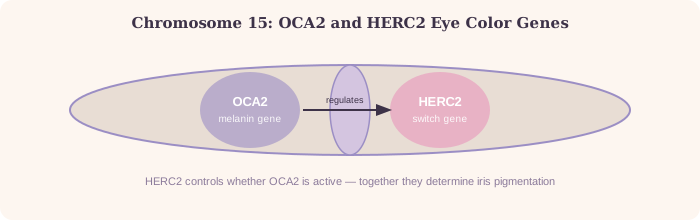
Consumer DNA testing services like 23andMe, AncestryDNA, and specialty genetic health services analyze actual DNA sequences at specific loci. For eye color, the key markers include:
A DNA test for eye color isn't just guessing from visible phenotype, it's reading the actual genetic letters at the positions that determine pigmentation. This is inherently more precise than inferring genotype from appearance.
Accuracy range: 80–90% overall, with some studies reporting 90%+ for the clearest binary cases (blue vs. non-blue). Hazel and green distinctions remain more difficult even with DNA data.
Best use cases: Highest-confidence prediction, useful for mixed-heritage families where phenotype-based inference is less reliable, forensic applications, understanding your own genetic profile.
The Trade-Offs
| Feature | Phenotype Calculator | DNA Test |
|---|---|---|
| Cost | Free | $80–$200+ |
| Speed | Instant | 3–6 weeks |
| DNA sample needed | No | Yes (saliva) |
| Accuracy | 70–85% | 80–90% |
| Reveals your genetics | No | Yes |
| Works for all ethnicities | Good | Better for diverse populations |
| Requires parents' DNA | No (just eye colors) | Yes (one or both parents) |
The 10–15% accuracy gap between calculator and DNA test matters for some families and not at all for others. If you're genuinely on the fence about whether a particular color outcome is likely, the DNA test provides stronger evidence. If you just want a reasonable estimate to discuss during pregnancy, the calculator is perfectly adequate.
Where Calculators Outperform Their Accuracy Numbers
The 70–85% figure describes overall accuracy across all input types. For specific common pairings, accuracy climbs higher:
For these clear-cut cases, there's genuinely little difference in practical usefulness between a calculator and a DNA test. The calculator's uncertainty is concentrated in edge cases: mixed-heritage couples, hazel vs. green boundaries, families with multiple unknown grandparents.
Where DNA Tests Outperform Calculators
Mixed-heritage families: When the dominant brown-eye population parent could be BB or Bb, a DNA test reads the actual genotype, eliminating that key uncertainty. Our mixed-heritage eye color guide explains why this inference is harder with phenotype-only inputs.
Hazel/green distinctions: The boundary between hazel and green is probabilistically messy in phenotype-based models. DNA tests can read the SLC24A4 variants that specifically differentiate these colors, producing sharper predictions for this range.
Unexpected family histories: If there are brown-eyed children from seemingly clear blue-eyed parent pairings in the family history, it suggests genetic complexity that phenotype models can't fully capture but DNA tests can investigate.
What Neither Method Can Tell You
Both approaches give you probabilities, not certainties. Even with perfect genotype data, eye color prediction is limited by:
The American Academy of Ophthalmology notes that no predictive method, phenotype or genotype, achieves 100% accuracy for the simple reason that eye color development involves probabilistic cellular processes, not deterministic outcomes.
Which Should You Use?
Use the [free eye color calculator](/baby-eye-color-calculator) if: You want a quick probability estimate during pregnancy, both parents have common, clearly identifiable eye colors, and you're not willing to pay for DNA testing.
Use a DNA test if: You want the most accurate estimate available, you're from mixed heritage backgrounds, there's unexplained eye color variation in either family tree, or you're interested in your own genetics beyond just eye color.
Use both if: You want to compare outputs and understand why any differences arise. Running both is actually a useful exercise in understanding what the phenotype-based model does and doesn't capture.
For more on the genetic science, see our OCA2 and HERC2 gene guide and the complete eye color genetics overview.