Quick Answer: Most newborns have blue or gray eyes because the melanocytes in the iris haven't started producing melanin yet. As pigment builds up over the first 6–12 months, the true genetic eye color emerges.
Newborns have a lot to adjust to in their first months, light, sound, faces, feeding schedules. But one thing new parents often notice right away is eye color. Specifically: why do so many babies have blue or gray eyes even when both parents have dark eyes?
The explanation is pure biology, and it's one of the more fascinating examples of how genetics and development work together.
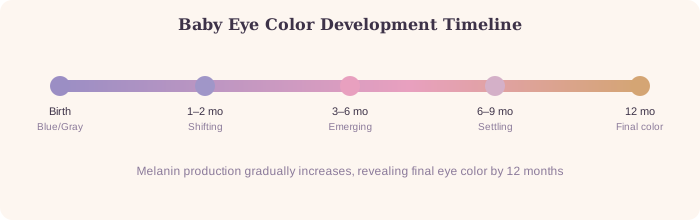
The Melanocyte Timing Explanation
The iris gets its color from melanocytes, pigment-producing cells embedded in the iris stroma. These cells make melanin, the same pigment responsible for skin and hair color.
Here's the key: melanocytes are present at birth, but they're largely inactive. They haven't yet received enough light stimulation to ramp up melanin production. Without melanin, the iris contains very little pigment, and unpigmented tissue appears to scatter blue-wavelength light, just like the sky or water. This Rayleigh scattering effect produces the blue or gray color most people associate with newborn eyes.
It's not that the eyes "are blue." It's that there's not enough pigment yet to show any other color.
When Does Melanin Start Appearing?
Melanin production in the iris typically begins within days of birth as the baby's eyes are exposed to light for the first time. But the accumulation is gradual:
First 1–2 months: Most babies still look blue or gray-blue. The eyes may appear slightly cloudy or "stormy." This is often the first sign of melanin beginning to deposit.
2–4 months: The shift begins in earnest for babies who will have darker eyes. Hazel and brown tones start appearing, often first around the pupil and spreading outward. Babies who will have lighter final colors (blue, green) may show little visible change.
4–6 months: Most babies' final eye color is at least partially visible. Brown eyes are usually identifiable by this point. Green and hazel eyes are developing their character. True blue-eyed babies are showing clearer, lighter blue rather than the murky newborn blue.
6–9 months: Eye colors are approaching their final form. The difference between "developing" blue and "final" blue is usually visible, final blue is clear and consistent rather than shifting.
9–12 months: Final color is established for most babies. The American Academy of Ophthalmology considers 12 months the reliable benchmark for stable eye color in most children.
Who Doesn't Start With Blue?
The "all newborns have blue eyes" generalization isn't universal. Babies with strong genetic backgrounds for high melanin production can have visibly brown or dark gray eyes very early, sometimes from birth.
This is most common in families of:
In these cases, melanocytes are genetically primed to activate faster and produce more melanin. The babies who start with clearly brown eyes almost never change, their color is locked in from the start, just displayed earlier.
The Special Case of Caucasian Newborns
Babies of Northern European and some Southern European heritage are statistically most likely to start with blue-gray eyes that subsequently change. The research consistently shows these populations have the highest rates of eye color change in the first year, driven by the genetics of lower baseline melanin expression that nonetheless activates over time.
This is the population where our baby eye color predictor is most useful for predicting change. A Caucasian baby's newborn eye color is genuinely less predictive of their final color than a South Asian baby's, because the developmental pathway is more variable.
Practical Milestones to Watch
For parents trying to track eye color development in their baby:
3 months: A reliable early indicator for brown. If brown is developing, you'll usually see it starting by now, particularly around the pupil.
6 months: A reasonable checkpoint for all colors. If you see clear blue at 6 months with no brown or green developing, blue is likely the final color. If you see green or hazel hints, those are likely to solidify.
12 months: The reliable confirmation point. Whatever color is present at 12 months is almost certainly the permanent eye color. Pediatric ophthalmologists use this as their reference point.
After 2 years: Changes become uncommon. Some very gradual deepening of color can occur, and hazel eyes may continue to appear variable between green and brown throughout life, but the fundamental color category is set.
Using Genetics to Predict, Not Just Wait
The biological timeline tells you when to expect the final color. The genetics tell you what color to expect. These are complementary questions, and both are useful.
If you know from the baby eye color calculator that there's an 80% probability of brown eyes, you can expect to see brown developing in the first 3–4 months. If blue is predicted at 85%, that's a good sign those newborn blue eyes will stay exactly as they are.
For a deeper look at how genetic probabilities are calculated, see our guide to what determines eye color. And if you're curious why some colors are rarer than others, the green eye genetics article explains why fewer than 2% of people worldwide have green eyes.