Quick Answer: Gray eyes in newborns are extremely common and reflect minimal melanin in the iris at birth. Most gray-eyed babies will develop either blue, green, hazel, or brown eyes within 6–12 months. True permanent gray eyes are uncommon but real.
Parents who peer into their newborn's eyes and see gray, not a clear blue, not brown, just a smoky, indeterminate gray, often wonder what that means. Is gray a color on its own? Is it a sign of eye problems? Is it just an early stage that will pass?
The answers are reassuring, and the genetics are interesting.
Why Gray Eyes Are So Common in Newborns
Nearly all babies are born with minimal iris melanin. The melanocytes, cells that produce melanin, are present but largely dormant at birth. Without melanin pigment, the iris scatters light in a way that produces blue or gray-blue tones.
Gray eyes differ from blue in the scattering pattern: blue eyes scatter shorter wavelengths (blue light) more strongly, giving a clearer blue appearance. Gray eyes scatter a broader range of wavelengths, producing a less saturated, achromatic quality, more "storm cloud" than "sky."
In practical terms, both gray and blue newborn eyes indicate low melanin. They're variants of the same underlying condition. Whether a newborn appears more blue or more gray often comes down to iris structure, thickness of the stroma layer, and how observers are perceiving and describing the color.
Will Gray Eyes Stay Gray?
Here's the trajectory by genetic outcome:
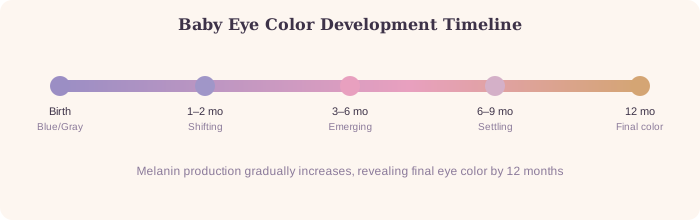
If the baby will have blue eyes: The gray tones typically clarify and brighten between 2 and 6 months as the iris structure settles and slight melanin variations stabilize. By 6 months, blue-eyed babies usually look clearly blue rather than gray.
If the baby will have green eyes: Gray can transition through a blue-gray phase to a clearer blue-green, then to the final green color over 6–12 months. Green eyes often look steely gray-green during development before the final hue appears.
If the baby will have hazel or brown eyes: The gray typically starts to warm or darken between 2 and 4 months. You'll see a yellow-gold or amber tint emerging from the gray, particularly around the pupil. This is melanin beginning to accumulate.
True gray eyes: In a small percentage of people, less than 1% globally, gray remains the permanent eye color. Permanent gray eyes have their own distinct genetics and structural features: lower total melanin than blue, with specific collagen arrangements in the iris stroma that scatter light toward the gray spectrum.
The Genetics of Permanent Gray Eyes
True permanent gray eyes are least well understood in eye color genetics research. They share some genetic overlap with blue eyes (low OCA2/HERC2 activity, minimal eumelanin) but appear to involve differences in iris stroma collagen density and arrangement that alter the scattering signature.
Research published in the European Journal of Human Genetics identified structural iris differences in gray-eyed individuals compared to blue-eyed individuals at the same level of melanin. This suggests iris architecture, not just pigment quantity, plays a meaningful role.
For our baby eye color calculator, gray eyes aren't a separate input category because the calculator focuses on the standard four phenotype categories used in Mendelian genetics research (brown, blue, green, hazel). If you have what you believe are truly gray eyes, selecting "blue" is the closest functional equivalent, both represent low-melanin, HERC2-suppressed phenotypes.
How to Monitor Your Baby's Gray Eyes
Watch these checkpoints:
2–3 months: Look for color warmth developing near the pupil. Amber tones = brown or hazel likely developing. Continued cool gray = blue or green path likely.
4–6 months: The direction should be clear by now. Gray that is lightening and clarifying = likely blue. Gray that shows green tints = likely green or hazel.
9–12 months: Final color established. If still clearly gray at 12 months with no warmth, you may have a genuinely gray-eyed baby. Rare, but real.
Are Gray Eyes a Health Concern?
In virtually all cases, no. Newborn gray eyes are a normal developmental state, and gray eyes in older children or adults are simply a structural variant, not a health marker.
The exceptions worth discussing with a pediatric ophthalmologist:
For typical gray eyes in a healthy newborn, no action needed. It's part of the normal range of newborn eye color development.
Using the Calculator When You Have Gray Eyes
If you're predicting your own baby's eye color and have gray eyes yourself, entering "blue" in our baby eye color prediction tool gives you the most accurate result. Gray and blue share the same core genetic architecture, HERC2 variants that suppress OCA2 activity, so the prediction logic applies the same way.
For more on how newborn eye development works, see our newborn eye color timeline guide. And if you're curious why some babies develop permanent blue while others start blue and shift to brown or green, the what determines eye color article explains the underlying melanin biology.